Nov 14, 2013 | Seasonality, trading strategies
OK I’ll admit I am a little early with this one. But maybe not as early as you might think. In fact, as I was out driving I saw the first house in my neighborhood to have Christmas lights up…and lit. Hey, desperate times I guess.
While the stock market continues to push to new highs, “morale” is not quite what one might expect. This may be due in part to the fact that it is near impossible to peruse the financial media these days and not come away with a sense of foreboding, given all of the warnings and admonitions and liberal use of word like “frothy” and “bubble.” And make no mistake, I have voiced a few concerns recently myself and have gone so far as to suggest that investors consider hedging with VXX call options (http://jayonthemarkets.com/2013/10/30/is-vxx-issuing-a-warning/) from time to time.
Still, as a person who has been involved in the financial markets for a while I understand the power of the trend. So despite all of my personal concerns about the economy, debt, etc., etc., 2013 has been good to “go with the flow” kind of people. In the short-term, the stock market does appear to be a bit “overbought” and perhaps “due for a correction.” But while anything can happen, history suggests that people who are looking for a stock market collapse before the end of the year may be disappointed. Cue the Christmas music.
The Santa Claus Rally
As I define it, the Santa Claus rally time period:
-Begins at the close of trading on the Friday before Thanksgiving.
-Extends through the close of the third trading day of January.
And that’s all there is to it.
So how has the stock market performed during this period in the past? I am so glad you asked.
Figure 1 displays the growth of $1,000 invested in the Dow Jones Industrials Average only during the pre-Thanksgiving through post-New Year’s period I just described, starting in November 1949.
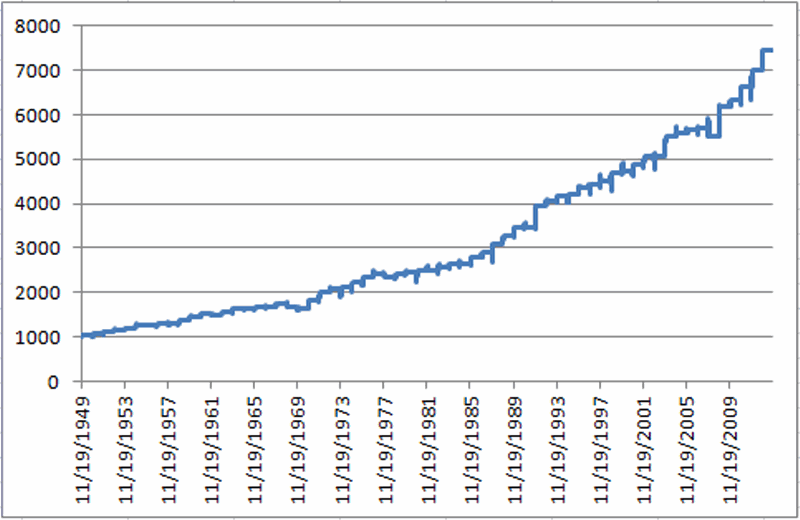
Figure 1 – Growth of $1,000 invested in Dow Jones Industrials during Santa Claus Rally period (1949-2012)
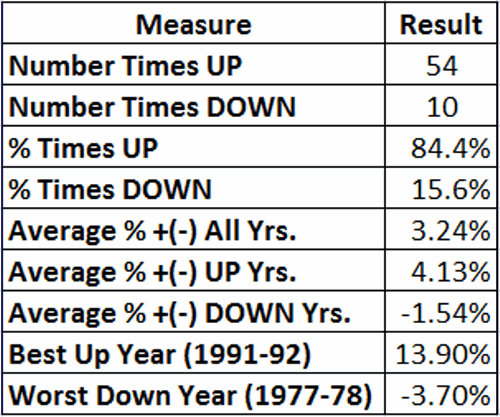
Figure 2 displays some important figures regarding this performance.
Figure 2 – Stock Market Performance during Santa Claus Rally Time Period
One other thing to note is that this Santa Claus Rally time period has witnessed an advance by the Dow during 26 of the last 28 and 32 of the last 35 years. It’s tough to the beat that kind of consistency.
Summary
So does all of this mean that “you can’t lose” trading stocks during this “sure thing” time period guaranteed to generate “above average, risk free” returns? Ah, if only. All any of this really means is that stocks have performed well during this time period in the past. What will happen this year remains to be seen.
Still, the real point is that investors may be wise to give the bullish case every benefit of the doubt starting in late November.
Jay Kaeppel
Chief Market Analyst at JayOnTheMarkets.com and AIQ TradingExpert Pro (http://aiq.com) client
Jay has published four books on futures, option and stock trading. He was Head Trader for a CTA from 1995 through 2003. As a computer programmer, he co-developed trading software that was voted “Best Option Trading System” six consecutive years by readers of Technical Analysis of Stocks and Commodities magazine. A featured speaker and instructor at live and on-line trading seminars, he has authored over 30 articles in Technical Analysis of Stocks and Commodities magazine, Active Trader magazine, Futures & Options magazine and on-line at www.Investopedia.com.
P.S. For all of you “numbers geeks” out there, the annual performance during the Santa Claus Rally Time period appears below
| Period Ending |
DJIA % +(-) |
|
1/5/50
|
3.6
|
|
1/4/51
|
4.0
|
|
1/4/52
|
3.9
|
|
1/6/53
|
4.6
|
|
1/6/54
|
2.9
|
|
1/5/55
|
5.1
|
|
1/5/56
|
0.2
|
|
1/4/57
|
3.7
|
|
1/6/58
|
(0.0)
|
|
1/6/59
|
5.7
|
|
1/6/60
|
5.8
|
|
1/5/61
|
3.2
|
|
1/4/62
|
(1.0)
|
|
1/4/63
|
5.0
|
|
1/6/64
|
5.0
|
|
1/6/65
|
(1.2)
|
|
1/5/66
|
3.0
|
|
1/5/67
|
(0.5)
|
|
1/4/68
|
4.3
|
|
1/6/69
|
(3.1)
|
|
1/6/70
|
(2.4)
|
|
1/6/71
|
10.0
|
|
1/5/72
|
11.6
|
|
1/4/73
|
3.4
|
|
1/4/74
|
2.0
|
|
1/6/75
|
3.6
|
|
1/6/76
|
6.0
|
|
1/5/77
|
3.1
|
|
1/5/78
|
(3.7)
|
|
1/4/79
|
3.6
|
|
1/4/80
|
1.6
|
|
1/6/81
|
1.5
|
|
1/6/82
|
0.9
|
|
1/5/83
|
2.3
|
|
1/5/84
|
2.5
|
|
1/4/85
|
(0.3)
|
|
1/6/86
|
5.7
|
|
1/6/87
|
4.3
|
|
1/6/88
|
6.5
|
|
1/5/89
|
6.2
|
|
1/4/90
|
5.4
|
|
1/4/91
|
0.6
|
|
1/6/92
|
13.9
|
|
1/6/93
|
2.4
|
|
1/5/94
|
2.8
|
|
1/5/95
|
0.9
|
|
1/4/96
|
3.7
|
|
1/6/97
|
1.5
|
|
1/6/98
|
1.8
|
|
1/6/99
|
4.2
|
|
1/5/00
|
1.1
|
|
1/4/01
|
2.7
|
|
1/4/02
|
4.0
|
|
1/6/03
|
(0.4)
|
|
1/6/04
|
9.5
|
|
1/5/05
|
1.3
|
|
1/5/06
|
1.1
|
|
1/5/07
|
0.4
|
|
1/4/08
|
(2.9)
|
|
1/6/09
|
12.0
|
|
1/6/10
|
2.5
|
|
1/5/11
|
4.6
|
|
1/5/12
|
5.3
|
|
1/4/13
|
6.7
|
Nov 11, 2013 | Uncategorized
In “Reversing MACD: The Sequel” in the November 2013 issue of Stocks and Commodities, author Johnny Dough presents functions that return price values for the MACD indicators. I am providing AIQ code for the following functions based on the AmiBroker code given in Dough’s article:
- PMACDsignal returns price where the MACD crosses its signal line or where there is an MACD histogram cross of the zero line
- PMACDlevel returns price where the MACD is equal to the level value
- PMACDeq returns price where the MACD is equal to the previous bar MACD.
I created some additional rules to show reports that display the price values of the functions:
- The ShowValues rule will display all function values for stocks that are over the minPrice level input
- The NearXO rule will list only those stocks that are less than or equal to the average range percentage of crossing over of the MACD oscillator
- The PMACxup rule lists cross-ups today on the MACD oscillator using the PMACDsignal price
- The PMACxdn “if” rule lists cross-downs today on the MACD oscillator using the PMACDsignal price.
The NearXO report is useful if you want to enter a position on a buy or sell stop-on-close when the MACD oscillator crosses zero. This report sorts by the MACD oscillator. The ones with a positive MACD oscillator amounts calculate the price that would be used to go short at the close for a cross-down on the oscillator. The ones with negative MACD oscillator amounts calculate the price that would be used to go long at the close for a cross-up on the oscillator.
I ran the NearXO report on September 10, 2013 using the NASDAQ 100 list of stocks. There were 12 that showed up on the report, meaning they were near a cross-up or cross-down of the MACD oscillator.
In Figure 5, I show a chart of Qiagen NV (QGEN), which appeared on the report. The report showed that a next day’s close price of 20.72 or higher would cause the MACD oscillator to go from negative to positive. On September 11, 2013, QGEN closed at 20.98 and the MACD oscillator moves to a positive number.
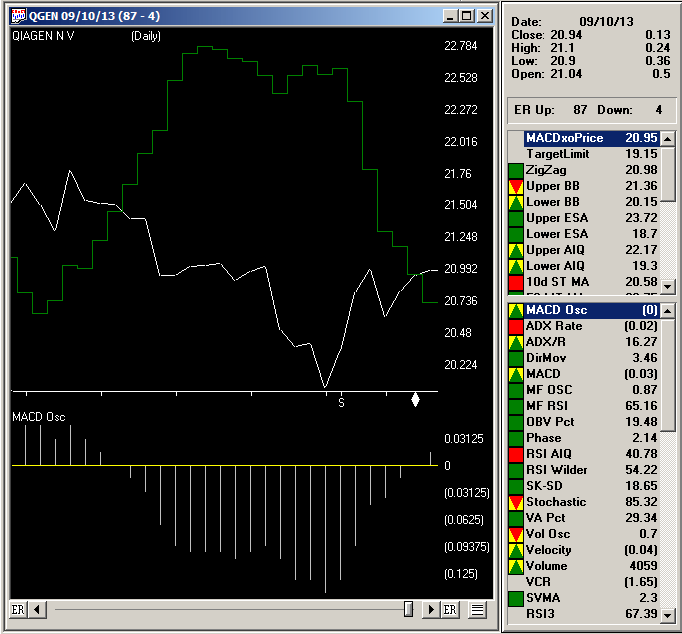
FIGURE 5: AIQ. Here’s a sample chart of QGEN with the MACD oscillator, looking for closing price (white line) and price to make a cross up or cross down on the oscillator (dark green line).
The AIQ code and EDS file can be downloaded from www.TradersEdgeSystems.com/traderstips.htm.
!REVERSING MACD: THE SEQUEL
!Author: Johnny Dough, TASC November 2013
!Coded by: Richard Denning 9/9/2013
!www.TradersEdgeSystems.com
!INPUTS:
price is [close].
period_X is 12.
period_Y is 25.
period_Z is 9.
level is 0.
minPrice is 10.
rangeFactor is 1.
!PMACDsignal returns price where MACD crosses signal line
! or MACD histogram cross of 0:
alphaX is 2 / ( 1 + period_X ).
alphaY is 2 / ( 1 + period_Y ).
alphaZ is 2 / ( 1 + period_Z ).
One_alphaX is 1 – alphaX.
One_alphaY is 1 – alphaY.
One_alphaZ is 1 – alphaZ.
MACDvalue is expavg( price, period_X ) – expavg( price, period_Y ).
MACDvalue_1 is valresult(MACDvalue,1).
MACDsignal is expavg( MACDvalue, period_Z ).
PMACDsignal is ( MACDsignal – expavg( price, period_X ) * one_alphaX
+ expavg( price, period_Y ) * one_alphaY ) / ( alphaX – alphaY ).
!PMACDlevel returns price where MACD is equal to level value
! e.g. PMACDlevel(0, C, 12, 16) would return the series
! where next price would make MACD=0
PMACDlevel is (Level + expavg( price, period_Y ) * one_alphaY
– expavg( price, period_X )* one_alphaX ) / ( alphaX – alphaY ).
!PMACDeq returns price where MACD is equal to previous bar MACD
PMACDeq is ( expavg( price, period_X ) * alphaX
– expavg( price, period_Y )* alphaY ) / ( alphaX – alphaY ).
!ADDITIONAL CODE NOT PROVIDED BY AUTHOR:
PMACDsignal_1 is valresult(PMACDsignal,1). !PLOT-OFFSET BY ONE DAY
MACDosc_1 is val([MACD osc],1). !Prior day’s MACD oscillator value
!RULES FOR GENERATING REPORTS:
PMACxup if price > PMACDsignal_1
and valrule(price <= PMACDsignal_1,1) and price > minPrice.
PMACxdn if price < PMACDsignal_1
and valrule(price >= PMACDsignal_1,1) and price > minPrice.
PMACDsigPct is (PMACDsignal / [close] – 1) * 100.
AvgRangePct is simpleavg(([high]/[low]-1)*100,200).
NearXO if price > minPrice and abs(PMACDsigPct) <= AvgRangePct*rangeFactor.
ShowValues if price > minPrice.
—Richard Denning
info@TradersEdgeSystems.com
for AIQ Systems
Nov 11, 2013 | indicators, MACD, trading strategies
In “Reversing MACD: The Sequel” in the November 2013 issue of Stocks and Commodities, author Johnny Dough presents functions that return price values for the MACD indicators. I am providing AIQ code for the following functions based on the AmiBroker code given in Dough’s article:
-
PMACDsignal returns price where the MACD crosses its signal line or where there is an MACD histogram cross of the zero line
-
PMACDlevel returns price where the MACD is equal to the level value
-
PMACDeq returns price where the MACD is equal to the previous bar MACD.
I created some additional rules to show reports that display the price values of the functions:
- The ShowValues rule will display all function values for stocks that are over the minPrice level input
- The NearXO rule will list only those stocks that are less than or equal to the average range percentage of crossing over of the MACD oscillator
- The PMACxup rule lists cross-ups today on the MACD oscillator using the PMACDsignal price
- The PMACxdn “if” rule lists cross-downs today on the MACD oscillator using the PMACDsignal price.
The NearXO report is useful if you want to enter a position on a buy or sell stop-on-close when the MACD oscillator crosses zero. This report sorts by the MACD oscillator. The ones with a positive MACD oscillator amounts calculate the price that would be used to go short at the close for a cross-down on the oscillator. The ones with negative MACD oscillator amounts calculate the price that would be used to go long at the close for a cross-up on the oscillator.
I ran the NearXO report on September 10, 2013 using the NASDAQ 100 list of stocks. There were 12 that showed up on the report, meaning they were near a cross-up or cross-down of the MACD oscillator.
In Figure 5, I show a chart of Qiagen NV (QGEN), which appeared on the report. The report showed that a next day’s close price of 20.72 or higher would cause the MACD oscillator to go from negative to positive. On September 11, 2013, QGEN closed at 20.98 and the MACD oscillator moves to a positive number.
FIGURE 5: AIQ. Here’s a sample chart of QGEN with the MACD oscillator, looking for closing price (white line) and price to make a cross up or cross down on the oscillator (dark green line).
The AIQ code and EDS file can be downloaded from www.TradersEdgeSystems.com/traderstips.htm.
!REVERSING MACD: THE SEQUEL
!Author: Johnny Dough, TASC November 2013
!Coded by: Richard Denning 9/9/2013
!www.TradersEdgeSystems.com
!INPUTS:
price is [close].
period_X is 12.
period_Y is 25.
period_Z is 9.
level is 0.
minPrice is 10.
rangeFactor is 1.
!PMACDsignal returns price where MACD crosses signal line
! or MACD histogram cross of 0:
alphaX is 2 / ( 1 + period_X ).
alphaY is 2 / ( 1 + period_Y ).
alphaZ is 2 / ( 1 + period_Z ).
One_alphaX is 1 – alphaX.
One_alphaY is 1 – alphaY.
One_alphaZ is 1 – alphaZ.
MACDvalue is expavg( price, period_X ) – expavg( price, period_Y ).
MACDvalue_1 is valresult(MACDvalue,1).
MACDsignal is expavg( MACDvalue, period_Z ).
PMACDsignal is ( MACDsignal – expavg( price, period_X ) * one_alphaX
+ expavg( price, period_Y ) * one_alphaY ) / ( alphaX – alphaY ).
!PMACDlevel returns price where MACD is equal to level value
! e.g. PMACDlevel(0, C, 12, 16) would return the series
! where next price would make MACD=0
PMACDlevel is (Level + expavg( price, period_Y ) * one_alphaY
– expavg( price, period_X )* one_alphaX ) / ( alphaX – alphaY ).
!PMACDeq returns price where MACD is equal to previous bar MACD
PMACDeq is ( expavg( price, period_X ) * alphaX
– expavg( price, period_Y )* alphaY ) / ( alphaX – alphaY ).
!ADDITIONAL CODE NOT PROVIDED BY AUTHOR:
PMACDsignal_1 is valresult(PMACDsignal,1). !PLOT-OFFSET BY ONE DAY
MACDosc_1 is val([MACD osc],1). !Prior day’s MACD oscillator value
!RULES FOR GENERATING REPORTS:
PMACxup if price > PMACDsignal_1
and valrule(price <= PMACDsignal_1,1) and price > minPrice.
PMACxdn if price < PMACDsignal_1
and valrule(price >= PMACDsignal_1,1) and price > minPrice.
PMACDsigPct is (PMACDsignal / [close] – 1) * 100.
AvgRangePct is simpleavg(([high]/[low]-1)*100,200).
NearXO if price > minPrice and abs(PMACDsigPct) <= AvgRangePct*rangeFactor.
ShowValues if price > minPrice.
—Richard Denning
info@TradersEdgeSystems.com
for AIQ Systems
Nov 6, 2013 | Uncategorized
This post is more of an FYI than a specific call to action, still a reasonably good trend is a reasonably good trend.
As many investors know by now the November 1st into May time period has historically been very good for the stock market. One of the better performing sectors during this time period has tended to be the semiconductor/electronics sectors. Among tickers worthy of analysis are:
-FSELX (Fidelity Select Electronics mutual fund)
-SMH (HOLDRs Semiconductor ETF)
In a nutshell, the semiconductor/electronics sectors tend to perform well between October 31st and April 30th. The results for FSELX since October 1994 appear in Figure 1.
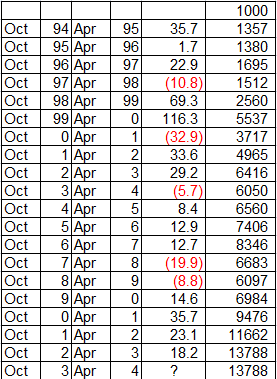
Figure 1 – FSELX Performance October 31 to April 30
A chart of the annual growth of $1,000 appears in Figure 2.
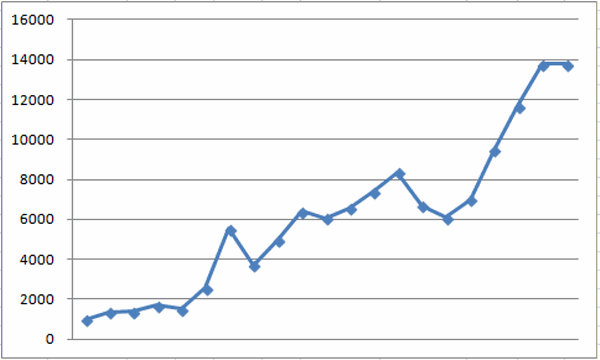
Figure 2 – $1,000 invested in FSELX 10/31 through 4.30 since 10/1994
In a nutshell:
-FSELX has been up 14 times (74%) and down 5 times (26%).
-The average gain was +18.7% and the median gain was +13.7%.
-The worst declines were -32.9% during 2000 to 2001 and -19.9% during 2007 to 2008, so remember that there is definitely risk involved
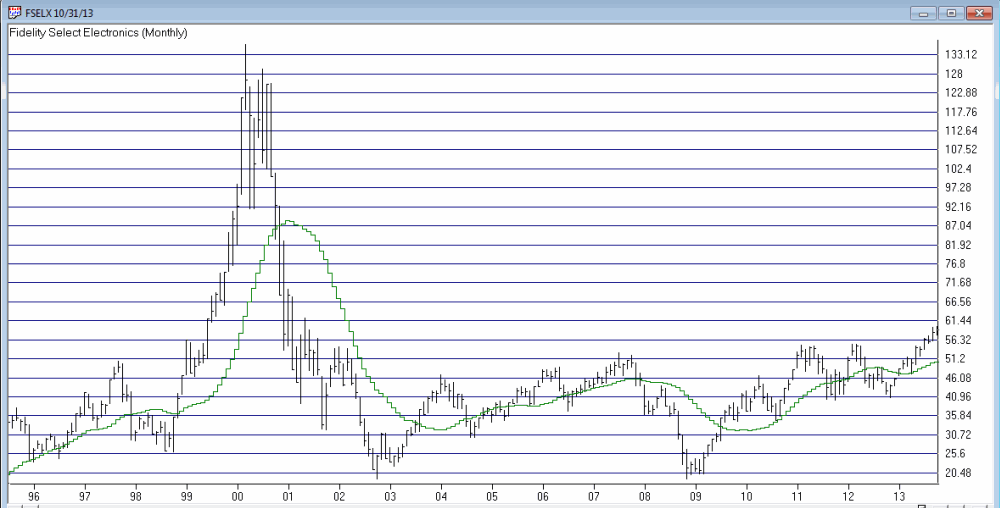 Figure 3 – Fidelity Select Electronics (Ticker FSELX) (Courtesy: AIQ TradingExpert)
Summary
Please do not read this post and think “Aha, semiconductor/electronic stocks are sure to rally.” That is not the implication I am trying to make. Simply remember that the “trend is your friend” and that this sector tends to perform well during this time period. As long as these stocks act well it may be wise to give the bullish case the benefit of the doubt.
ay Kaeppel
Chief Market Analyst at JayOnTheMarkets.com and AIQ TradingExpert Pro (http://aiq.com) client
Jay has published four books on futures, option and stock trading. He was Head Trader for a CTA from 1995 through 2003. As a computer programmer, he co-developed trading software that was voted “Best Option Trading System” six consecutive years by readers of Technical Analysis of Stocks and Commodities magazine. A featured speaker and instructor at live and on-line trading seminars, he has authored over 30 articles in Technical Analysis of Stocks and Commodities magazine, Active Trader magazine, Futures & Options magazine and on-line at www.Investopedia.com.
Nov 6, 2013 | Seasonality, sector funds, trading strategies
This post is more of an FYI than a specific call to action, still a reasonably good trend is a reasonably good trend.
As many investors know by now the November 1st into May time period has historically been very good for the stock market. One of the better performing sectors during this time period has tended to be the semiconductor/electronics sectors. Among tickers worthy of analysis are:
-FSELX (Fidelity Select Electronics mutual fund)
-SMH (HOLDRs Semiconductor ETF)
In a nutshell, the semiconductor/electronics sectors tend to perform well between October 31st and April 30th. The results for FSELX since October 1994 appear in Figure 1.
Figure 1 – FSELX Performance October 31 to April 30
A chart of the annual growth of $1,000 appears in Figure 2.
Figure 2 – $1,000 invested in FSELX 10/31 through 4.30 since 10/1994
In a nutshell:
-FSELX has been up 14 times (74%) and down 5 times (26%).
-The average gain was +18.7% and the median gain was +13.7%.
-The worst declines were -32.9% during 2000 to 2001 and -19.9% during 2007 to 2008, so remember that there is definitely risk involved
Figure 3 – Fidelity Select Electronics (Ticker FSELX) (Courtesy: AIQ TradingExpert)
Summary
Please do not read this post and think “Aha, semiconductor/electronic stocks are sure to rally.” That is not the implication I am trying to make. Simply remember that the “trend is your friend” and that this sector tends to perform well during this time period. As long as these stocks act well it may be wise to give the bullish case the benefit of the doubt.
ay Kaeppel
Chief Market Analyst at JayOnTheMarkets.com and AIQ TradingExpert Pro (http://aiq.com) client
Jay has published four books on futures, option and stock trading. He was Head Trader for a CTA from 1995 through 2003. As a computer programmer, he co-developed trading software that was voted “Best Option Trading System” six consecutive years by readers of Technical Analysis of Stocks and Commodities magazine. A featured speaker and instructor at live and on-line trading seminars, he has authored over 30 articles in Technical Analysis of Stocks and Commodities magazine, Active Trader magazine, Futures & Options magazine and on-line at www.Investopedia.com.

 English