Oct 7, 2011 | Uncategorized
By Jay Kaeppel
No single indicator will accurately forecast or coincide with every market top or bottom. Here, two indicators have been combined to form one indicator that can increase your chances of identifying buy or sell points.
As a student of the market, I have crunched a few numbers over the years. At the same time I have tried, and cautioned others also, to avoid the temptation to divide one number by another or multiply one number by another simply because we can.
Not every calculation involving market indicators enjoys any real purpose. In addition, many indicators react in a manner similar to other indicators. Almost all overbought/oversold indicators tend to get more oversold as the market declines and more overbought as the market rallies. So stringing together more than a handful of similar indicators does not necessarily provide any additional benefit.
The AIQ EDS code for Jay Kaeppel’s Jkhl indicator discussed in his article in this issue, “The JK HiLo Index,” can be downloaded from www.TradersEdgeSystems.com/traderstips.htm.

AIQ SYSTEMS, THE JK HILO INDEX. This chart shows the JKHL indicator on a chart of the S&P 500 index together with a 200-bar moving average.
! THE JK HILO INDEX
! Author: Jay Kaeppel, TASC October 2011
! Coded by: Richard Denning 8/12/2011
! www.TradersEdgeSystems.com
! HIGH-LOW INDICATORS:
! JKlogic:
NewH is TickerUDF(“OCEXCH”,[New Highs]).
NewL is TickerUDF(“OCEXCH”,[New Lows]).
Adv is TickerUDF(“OCEXCH”,[Adv Issues]).
Dec is TickerUDF(“OCEXCH”,[Dec Issues]).
Unch is TickerUDF(“OCEXCH”,[Unch Issues]).
Tot is Adv + Dec + Unch.
PctNH is (NewH / Tot) * 100.
PctNL is (NewL / Tot) * 100.
HLidx is min(PctNH,PctNL).
avgHLidx is simpleavg(HLidx,10).
! JK VERSION OF HIGH LOW LOGIC INDICATOR:
JKlogic is iff(avgHLidx > 2.15 or avgHLidx < 0.40,avgHLidx,1).
! JK NEW HIGH PERCENT:
JKnH is simpleavg(NewH / (NewH + NewL),10).
! COMBINED TWO JK INDICATORS:
!Plot as single line with upper 90 lower 20 support
JKHL is JKlogic * JKnH * 100.
—Richard Denning
info@TradersEdgeSystems.comThis e-mail address is being protected from spambots. You need JavaScript enabled to view it.
for AIQ Systems
Oct 7, 2011 | Uncategorized
By Jay Kaeppel
No single indicator will accurately forecast or coincide with every market top or bottom. Here, two indicators have been combined to form one indicator that can increase your chances of identifying buy or sell points.
As a student of the market, I have crunched a few numbers over the years. At the same time I have tried, and cautioned others also, to avoid the temptation to divide one number by another or multiply one number by another simply because we can.
Not every calculation involving market indicators enjoys any real purpose. In addition, many indicators react in a manner similar to other indicators. Almost all overbought/oversold indicators tend to get more oversold as the market declines and more overbought as the market rallies. So stringing together more than a handful of similar indicators does not necessarily provide any additional benefit.
The AIQ EDS code for Jay Kaeppel’s Jkhl indicator discussed in his article in this issue, “The JK HiLo Index,” can be downloaded from www.TradersEdgeSystems.com/traderstips.htm.
AIQ SYSTEMS, THE JK HILO INDEX. This chart shows the JKHL indicator on a chart of the S&P 500 index together with a 200-bar moving average.
! THE JK HILO INDEX
! Author: Jay Kaeppel, TASC October 2011
! Coded by: Richard Denning 8/12/2011
! www.TradersEdgeSystems.com
! HIGH-LOW INDICATORS:
! JKlogic:
NewH is TickerUDF(“OCEXCH”,[New Highs]).
NewL is TickerUDF(“OCEXCH”,[New Lows]).
Adv is TickerUDF(“OCEXCH”,[Adv Issues]).
Dec is TickerUDF(“OCEXCH”,[Dec Issues]).
Unch is TickerUDF(“OCEXCH”,[Unch Issues]).
Tot is Adv + Dec + Unch.
PctNH is (NewH / Tot) * 100.
PctNL is (NewL / Tot) * 100.
HLidx is min(PctNH,PctNL).
avgHLidx is simpleavg(HLidx,10).
! JK VERSION OF HIGH LOW LOGIC INDICATOR:
JKlogic is iff(avgHLidx > 2.15 or avgHLidx < 0.40,avgHLidx,1).
! JK NEW HIGH PERCENT:
JKnH is simpleavg(NewH / (NewH + NewL),10).
! COMBINED TWO JK INDICATORS:
!Plot as single line with upper 90 lower 20 support
JKHL is JKlogic * JKnH * 100.
—Richard Denning
info@TradersEdgeSystems.comThis e-mail address is being protected from spambots. You need JavaScript enabled to view it.
for AIQ Systems
Sep 12, 2011 | Uncategorized
Steve Palmquist.
Author of ‘The Timely Trades Letter’. ‘How to Take Money from the Markets’, and Money-Making Candlestick Patterns.
Serious traders will go through a learning curve as they study market behavior and how their trading systems function. They will have times when they run into situations that have not been experienced or researched and they may be unsure of what to do. This is normal, it is the price of admission to the trading business. My general rule is that when I am unsure I close the position. It is hard to go broke taking profits so my focus is on needing a clear reason to stay in a position, not wondering whether or not I should get out. If there is no clear reason to hold I take profits and move on to another trade.
When trading I am not holding out for the perfect trade, there is no such thing. Trading is about managing risks and I use the current market conditions to determine how many trades to be taking and the appropriate position sizing to use. Setups with more room to run are prioritized above ones with little room to run. Setups triggering on stronger volume compared to the previous days volume are prioritized above ones with lower trigger day volume. Setups with shallower pullbacks are prioritized above ones with deeper pullbacks. I then look at the setups that are triggering and start from the top of the prioritized list and work down until I run out of setups or fill the number of positions I am interested in.
The successful trader has a tool box with a variety of trading tools for use in different market conditions. The trader, like the carpenter, must go beyond just acquiring the tools. Traders must understand which tool to use for a specific task, and have a clear understanding of how the tool works, and what can and cannot be done with it. I have extensively tested several trading systems, the results of this testing on specific trading trading tools are outlined in ‘How to Take Money from the Markets’, and Money-Making Candlestick Patterns. The testing process helps us understand how stocks usually behave after forming a specific pattern such as being outside the Bollinger Bands, showing strong distribution or accumulation, or pulling back or retracing during a trend. Understanding what a stock is most likely to do forms the beginning of a trading strategy. Trading without this information is taking unknown risks.
Aug 29, 2011 | Uncategorized
Steve Palmquist.
Author of ‘The Timely Trades Letter’. ‘How to Take Money from the Markets’, and Money-Making Candlestick Patterns.
At a recent trading conference several traders were talking about exit strategies at lunch and one noted that he ‘liked to hold positions for about a week’. When asked why, he had no reason for the decision; it just ‘felt right’ to him. Trading on tips, emotions, or what ‘just feels right’ is unlikely to produce good long term results. Trading should be based on the careful analysis and testing of each trading system that a trader uses. Testing does not eliminate risk or guarantee results, but it can help to give a good idea of how a system has actually performed.
In trading range market environments I generally exit a position if the stock approaches the upper Bollinger Band or a horizontal resistance point. I do not want to hold out for the last dime, I want to be taking profits as the stock approaches resistance. In a trading range market it is generally better to get out too early than too late. It is tough to go broke taking profits. By definition the market usually retraces at resistance. If the market usually retraces from resistance then I want to be out of the position before it does and use the funds for another trade that is just triggering and starting its run.
Eventually almost all resistance areas are broken, but if the stock usually retraces at resistance then I want to go with the odds and be positioned to profit if the stock does the normal thing and retraces. If it does retrace I have my profits and can use them in a new trade. If the stock breaks above resistance I still have my profits and can still take another trade. From a risk management standpoint I am better off to have taken the profits. I am always trying to position myself to profit if the market and my positions do the normal thing. When something unusual happens I may loose a few bucks, but by definition unusual things do not happen often. One of the keys to trading is learning what usually happens in a given situation and then being positioned to profit if it does.
The successful trader has a tool box with a variety of trading tools for use in different market conditions. The trader, like the carpenter, must go beyond just acquiring the tools. Traders must understand which tool to use for a specific task, and have a clear understanding of how the tool works, and what can and cannot be done with it. I have extensively tested several trading systems, the results of this testing on specific trading trading tools are outlined in ‘How to Take Money from the Markets’, and Money-Making Candlestick Patterns. The testing process helps us understand how stocks usually behave after forming a specific pattern such as being outside the Bollinger Bands, showing strong distribution or accumulation, or pulling back or retracing during a trend. Understanding what a stock is most likely to do forms the beginning of a trading strategy. Trading without this information is taking unknown risks.
Aug 1, 2011 | Uncategorized
The Fibonacci time zones discussed in “Automated Techniques For Intraday Traders” by Andrew Coles in this issue (August 2011 Stocks & Commodities) can be implemented using the Fibonacci time zone chart tool in AIQ with no additional programming required.
Thus, I am instead providing code for the “Three Black Crows” candle pattern that is discussed in Thomas Bulkowski’s June 2011 article, “Top 10 Candles That Work.”
Coding candlestick patterns requires quite a bit of interpretation, since these patterns are described in relative terms like a “tall” candle or “closes in the lower portion of the bar.” Depending on the interpretation given to these relative terms, we can get different results. In my code set, shown below, I provide inputs that allow for some of the adjustments. The three black crows pattern has the following rules:
- Must have three tall candles in a row
- Pattern occurs in an uptrend and the first candle is the highest high
- The last two candles must open in the real body range of the prior candle
- All three must close near the low
- The last two candles must have lows that are lower than the prior low.
“Tall” means that the bars’ high–low range is greater than the 10-day average range that occurs just prior to the start of the pattern. An uptrend is defined as a linear regression slope of the closes greater than zero. “Closing near the low” is based on how many candle zones are input, which are then used to divide the range of the bar into zones. “Closing near the low” means that the close must fall in the lowest zone. In addition, the author suggests testing in a bull market. Bull market is defined here as when the 200-bar moving average of the Standard & Poor’s 500 is greater than it was 10 bars ago. A bear market occurs whenever it is not a bull market.
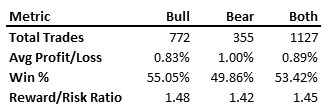
I tested the pattern by entering at the close on the day the pattern is complete and exiting at the close six days later. This provides a test with five overnights and five full bars held after the pattern completes. I used the Russell 3000 list of stocks and tested from 1/15/1970 to 6/13/2011. In the table in Figure 8, I show the comparative results of bull, bear, and combined bull and bear. It appears that this pattern works in both bull and bear markets, but there may not be enough signals to build a trading system from just this pattern alone.
This table shows the metrics for the three
black crows candle pattern for the test period
1/15/1970 to 6/13/2011 using the Russell 3000 list of stocks.
The AIQ code is shown here and the Eds file for this technique can be downloaded from www.TradersEdgeSystems.com/traderstips.htm.
AIQ code for three black crows pattern

!TOP 10 CANDLES THAT WORK: THREE BLACK CROWS
!Author: Thomas N. Bulkowski, TASC June 2011
!Coded by: Richard Denning 6/14/11

!INPUTS:
RangeLen  is 10.
CandleZones  is 4.
HHLen   is 10.
UpTrendLen  is 10.

! ABBREVIATIONS:
C  is [close].
C1 is valresult(C,1).
C2 is valresult(C,2).
H  is [high].
L  is [low].
L1 is valresult(L,1).
O  is [open].
O1 is valresult(O,1).
OSD  is offSetToDate(month(),day(),year()).

!BULL / BEAR MARKET DETERMINATION:
SPXc is TickerUDF("SPX",C).
Bull if simpleavg(C,200) > simpleavg(C,200,10).
Bear if not Bull.

!FUNCTIONS AND RULES FOR THREE BLACK CROWS CANDLE PATTERN:
Range is H - L.
HHoffset is scanany(H = ∧highresult(H,HHLen),HHLen) then OSD.
AvgRng is simpleavg(Range,RangeLen,∧HHoffset).
LowerZoneC if C < L + (Range * 1/CandleZones).
Tall if Range > AvgRng.
BlackCrow1 if Tall
 and LowerZoneC
 and slope2(C,UpTrendLen) > 0
 and  H = highresult(H,HHLen).
BlackCrow2 if Tall
 and LowerZoneC
 and O <= O1
 and O >= C1.
ThreeBlackCrows if valrule(BlackCrow1,2)
 and countof(BlackCrow2,2)=2
 and countof(L < L1,2)=2.
Bull3BlackCrows if Bull and ThreeBlackCrows.
Bear3BlackCrows if Bear and ThreeBlackCrows.
 English