Jan 31, 2011 | Uncategorized
Every trading day, the price of a stock is determined by a struggle between supply and demand. In technical analysis, charting a security is critical because it shows the interaction of supply and demand. The demand fluctuates at any given moment from a variety of factors, some rational and some irrational.
As a stock enters into a period of fluctuation, one of several traditional chart patterns may emerge. The pattern we’ll focus on in this article is the Symmetrical Triangle.
The Symmetrical Triangle pattern has two sloping trendlines that converge to each other. That is, a stock fluctuates up and down but each move is smaller than its predecessor. The descending tops in the price movement are defined by a downward sloping boundary line (resistance line) and the low points in the fluctuation can be defined by an upward sloping line (support line). The top and bottom boundaries need not be of equal length.
With the Symmetrical Triangle pattern, it’s seldom that a clue is given on the chart indicating which direction will eventually be broken. This is an attractive pattern for day-traders. That’s because good tradable moves come after a period of reduced volatility and because the pattern lends itself to tight stops. I’ll explain with an example. The chart below shows a one-minute chart of the S&P 500 Notice that after rallying in the morning, the S&P 500 stalls and begins to move sideways. In the 11:00 hour the index enters the Symmetrical Triangle pattern. Each rally is less than the previous rally and each decline is less than the previous decline.
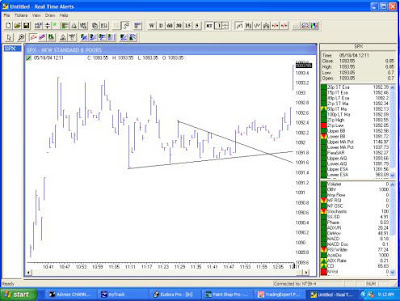
As the pattern develops, volatility falls. The eventual break came to the upside. After the break, investors had several minutes to act on the signal before the S&P 500 jumped higher. Once the pattern is broken, a tight stop can be placed using trendlines. In this case, the break was to the upside so the stop is placed just below the support trendline (lower trendline). If the break occurred to the downside, the stop would be placed just above the resistance trendline.
Realtime Point & Figure charts can help identify this pattern. Unlike bar charts where the vertical coordinate is based on price and the horizontal coordinate is based on time, the Point and Figure chart is only concerned with price. Since time is not a factor, small fluctuations in price are often not charted. Without these disturbances, it is easier to spot emerging patterns.
The figure below shows the S&;P 500’s Point & Figure chart using the same date as the first chart. The Symmetrical Triangle is seen at the very end of the pattern.
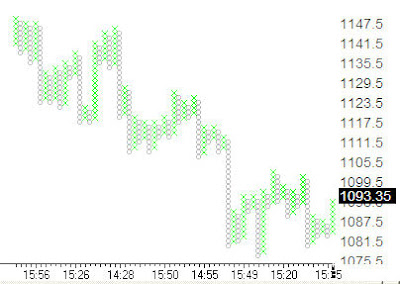
Looking at the last five columns, each rally (the Xs in the chart) is less than or equal to the previous rally and each decline (the Os in the chart) is greater than or equal to the previous decline. In this chart I elected to have a small box size (1.5 S&P 500 points per box) to make the chart more responsive and appropriate for active trading. It is also the reason behind the small Xs and Os. By increasing the box size, the Xs and Os will appear larger on the monitor.
The figure below shows Bed Bath & Beyond (BBBY) using a $0.20 box size. The larger Xs and Os make it easy to spot the Symmetrical Triangle pattern.
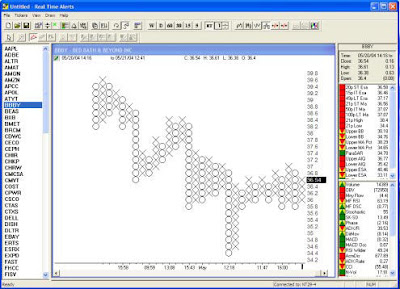
In the center of the pattern, BBBY enters a period where each rally is less than the previous rally and each sell-off is less than the previous sell-off. The bearish signal came once BBBY fell below the pattern and the column of Os fell below the previous column of Os. The Symmetrical Triangle pattern is an attractive pattern for active traders because tradeable moves often come after periods of reduced volatility and because the pattern allows for time stops. You can identify the pattern using traditional bar charts or with the real-time Point & Figure charts. Most people find it is easier to identify the pattern using the Point & Figure technique.
Jan 14, 2011 | Uncategorized
My very special guest, Adrienne Toghraie joined us today for an excellent presentation on ‘Modeling Success Qualities of Top Traders’
Adrienne, founder of TradingonTarget and author of 12 books, is an expert on coaching traders and investors to their next level of success by helping them overcome their self-imposed limitations.
This Webinar-workshop was about learning the qualities you need to acquire for running a successful trading business in order to become a master trader. Here are the categories Adrienne discussed:
• Entrepreneur Qualities
• Trader Qualities
• Emotional Stability Qualities
• People Skill Qualities
• Mastery Qualities
Many of you have busy schedules and some missed out on the event, however we have recorded the entire event and it’s available for you to view at
http://prowebinars.na5.acrobat.com/p36555229/
We look forward to seeing you at our next scheduled event on Januuary 26, 2011. I will be presenting ‘How to test a trading strategy using a systematic approach’.
Register now at http://tradingontarget.omnovia.com/registration/pid=51731291740818
Jan 3, 2011 | Uncategorized
Stocks & Commodities Magazine Traders Tips – January 2011 “Combining RSI with RSI” by Peter Konner
Optimization and stop-losses can help you minimize risks and give you better returns.
You would like to be long in a market that’s trending up, but what about when the trend turns down? Do you exit and just watch from the sidelines, or do you try to trade on the corrections in the downtrend? Here’s a simple combination where you can trade long-term uptrends and short-term corrections, all in one chart.
One of my previous strategies didn’t allow me to enter a trade and stay there in a long and strong uptrend, since the strategy was designed to use the relative strength index (Rsi) on a daily basis. The total return from my Rsi strategy was fair, but there were many trades with little return, especially in volatile markets.
I decided to build a new strategy with these requirements……read more at http://www.traders.com/Documentation/FEEDbk_Docs/2011/01/Konner.html
Rich Denning has coded this indicator for AIQ EDS, you can pick up the code from Rich’s website at http://www.tradersedgesystems.com/aiq/traderstips/traders-tips-january-2011.htm
Dec 22, 2010 | Uncategorized
Stock moves are based on fear and greed. Unfortunately, basing buying decisions on greed and selling decisions on fear leads to bad decisions. Buying greed and selling fear leads to buying high and selling low. It’s not just the execution price that is the problem, however. Being controlled by fear and greed leads to bad money management decisions. Nearly all investors can state a case where they were extremely confident about a stock — and whether it was based on a strong technical or fundamental picture, greed takes over and money management decisions are ignored.
The stock may be at $10 and you are certain that it will hit $20. As a result, you load up on the stock with a large portion of your assets. Unfortunately, before hitting $20 the stock falls to $7. You were right about the move but wrong on the timing. Because you had too much money invested, you couldn’t stomach the drawdown and the stock was sold for a loss.
The lesson to long-term success is proper allocation of your assets. In our example, if the investor had not loaded up on the stock trade, he could have ridden out the short-term decline and enjoyed the benefits of his correct projection.
Many traders lose everything in the markets because they wager an inappropriate percentage of their trading capital on a single position. Unfortunately, that single position invariably turns out to be the worse of all the holdings. When the trade goes badly, the adverse effect is crippling.
Staying power is important in successful trading. While valuation, trend direction, and timing are all important, proper position sizing is the most critical. With proper position sizing you can be wrong and play another day. With bad position sizing, you’ll end up with big losses and little hope of recovery.
Instead of buying from greed, treat every position like it could be a loser. Yes, there is power in positive thinking but overconfidence leads to bad results. Recall that 80% of all motorists think they are above average behind the wheel. Shun your pride and you will make better decisions. Don’t attribute winning positions to smarts and losing positions to bad luck.
Having a positive attitude about your trading system and your longterm goals are important. However, overconfidence in any single trade can cause you to mismanage it by taking on an undue amount of risk. If you believe every trade will be a winner, the need to confirm that belief may cause you to stay too long in a trade that has moved against you.
It may also prompt you to take a position size that is simply too large. Staying in a trade longer than you should or having too much money at risk is the surest road to disaster.
Dec 22, 2010 | Uncategorized
Stocks & Commodities Magazine Traders Tips – December 2010
“Trading Indexes With The Hull Moving Average” by Max Gardner
The full article is at http://www.traders.com/Documentation/FEEDbk_docs/2010/12/Gardner.html
Rich Denning has coded this indicator for AIQ EDS, you can pick up the code from Rich’s website at
http://www.tradersedgesystems.com/aiq/traderstips/traders-tips-december-2010.htm
Dec 21, 2010 | Uncategorized
01/13/2011 4:30 PM Eastern Time, register at http://prowebinars.na5.acrobat.com/modelingsuccess/event/event_info.html
ADRIENNE is considered an expert by her peers in the financial community for coaching traders, brokers, and investors to their next level of success. Her 11books on the psychology of trading have been highly praised by financial magazines. Adrienne’s public seminars and private counseling have achieved a wide level of recognition and popularity, as well as her television appearances and keynote addresses at major industry conferences. Adrienne has coached some of the most success- ful people in the world. What makes these great people unique? What makes them so success- ful? The answers to these and other questions are explored in her seminars, books, CDs, and DVDs, which form the core of Adrienne’s Modeling Excellence work with professionals who want to reach higher levels of success.
Dec 8, 2010 | Uncategorized
AIQ’s unique group/sector ability allows us to create our own groups from tickers in our database. The ability to create your own markets can take your analysis one step further by building a complete breadth data file of any collection of tickers. There are clear advantages to doing this, find out more in this 40 minute FREE webinar http://prowebinars.na5.acrobat.com/p41065877/
Dec 8, 2010 | Uncategorized
AIQ’s unique group/sector ability allows us to create our own groups from tickers in our database. The ability to create your own markets can take your analysis one step further by building a complete breadth data file of any collection of tickers. There are clear advantages to doing this, find out more in this 40 minute FREE webinar http://prowebinars.na5.acrobat.com/p41065877/
Nov 13, 2010 | Uncategorized
Finally it’s happened. After much lobbying from our clients, we’ve been persuaded to release the raw and uncut recordings from 5 of the sessions at the October seminar in Las Vegas.
The attendees who joined us this year all agreed; this year’s seminar was one of the best ever. With these recorded sessions, you hear the speaker and see the presentation or live charts the speaker showed the attendees.
This is the raw and uncut recordings, no editing, it is what it is. Check out the speakers and topic below, then at the bottom of the page, you’ll see the price. Attendees for the 2-day seminar paid up to $996 for 2 full days of sessions, so I think you’ll agree you’re getting a good deal.
Intermarket analysis – Profitable trading strategies for commodities, stocks, bonds and currencies.
I’m exhausted – How to identify when a ticker has exhausted a move up or down and what to do next.
Around the world in 80 minutes – Global equity investment opportunities to capitalize on future trends.
The relationship between commodities and currencies in the context of the MACDI divergence strategy.
The Band wagon – AIQ Bands, Bollinger Bands, Keltner Bands; Effective use of Bands in trading decisions.
More info on speakers and topics at http://aiqsystems.com/vegas2010webinarrecord.htm
5 SESSIONS BUNDLED PACKAGE
Delivered streaming from our high speed server.
Watch them as often as you want, as many times as you want.
ONLY $279

or call 1-800-332-2999
Oct 23, 2010 | Uncategorized
Steve Palmquist
Author of ‘The Timely Trades Letter’ and ‘How to Take Money from the Markets’
During 20 years of active trading experience I have researched, tested, and analyzed a number of trading systems and techniques. Some have shown promising results, some do not. I add tools to my trading toolbox based on their effectiveness. Trading systems are not effective because Aunt Millie or uncle Bob told you about them, they are effective because they work. One way to know if a trading technique works is through testing to see how different time periods, market conditions and parameters effect trading pattern results.
Making money in the stock market requires knowledge of what to trade, when to trade, and a variety of trading tools designed for different market conditions. Just as a carpenter will use several different tools when building a house, traders will use different tools to build their account. Using the same trading tool in all situations is like trying to build a house with just a hammer. Carpenters have tools designed for specific jobs, and so should traders.
The successful trader has a tool box with a variety of trading tools for use in different market conditions. The trader, like the carpenter, must go beyond just acquiring the tools. Traders must understand which tool to use for a specific task, and have a clear understanding of how the tool works, and what can and cannot be done with it.
Some tools, like a screwdriver, are fairly easy to learn how to use. Other tools, like a table saw, require a lot more training and experience to get the most out of. Most carpenters serve an apprentice period where they work with, and learn from, someone with years of experience. It is amazing how many people will just start trading their hard earned money without ‘learning the trade’ first. Understanding how to trade requires the ability to recognize basic trading patterns, and also knowledge of the market environments in which they work best.
There are no perfect trading systems, no matter what those slick brochures we all get in the mail say. Trading is a statistical business where it is important to manage risk. Every trading system has a certain percentage of winners and losers. Examples of six complete trading systems and how they perform in different market conditions is covered in ‘How to Take Money from the Markets’
There is no magic to trading. It is about putting the odds on your side and not trading unless they are. This sounds simple, but it takes…
a few years to get good at it. And like most things, while you are learning it is best to work with someone. The learning time is long because traders have to see how things behave in different markets, and learn to trade the odds and not their feelings. See www.daisydogger.com for more information on my trading experiences.
The market will not adapt to us, we must adapt to it. Active trading in a narrow range presents higher than average risk. Traders can compensate for higher risk market conditions by trading fewer positions and using smaller position sizes. Failure to do this can be costly.
I cannot control what the market does, so I have a plan for whichever path it picks and then trade the plan.
Successful trading is not about predicting what the market is going to do. It is about knowing how to react to whatever it does.
Always be thinking about taking and protecting profits.
You do not need to trade every day. Let the setups come to you and take the best ones. When the market is moving there lots of good setups to trade. If there are few setups, or most are failing, then listen to the message of the market.
Never enter a position without a plan for exiting.
Steve Palmquist a full time trader who invests his own money in the market every day. He has shared trading techniques and systems at seminars across the country; presented at the Traders Expo, and published articles in Stocks & Commodities, Traders-Journal, The Opening Bell, and Working Money.
Steve is the author of two trading books: “Money-Making Candlestick Patterns, Backtested for Proven Results’, in which he shares backtesting research on popular candlestick patterns and shows what actually works, and what does not.
“How to Take Money From the Markets, Creating Profitable Trading Strategies” in which he uses the results of extensive backtesting techniques to smash trading myths and get to the truth of what has worked and what has not. The book provides six fully analyzed and tested trading systems and shows how they have performed in different market conditions.
Steve is the publisher of the, ‘Timely Trades Letter’ in which he shares his market analysis and specific trading setups for stocks and ETFs. To receive a sample of the ‘Timely Trades Letter’ send an email to sample@daisydogger.com. Steve’s website:www.daisydogger.com provides additional trading information and market adaptive trading techniques.



 English